
BRICKⓈ
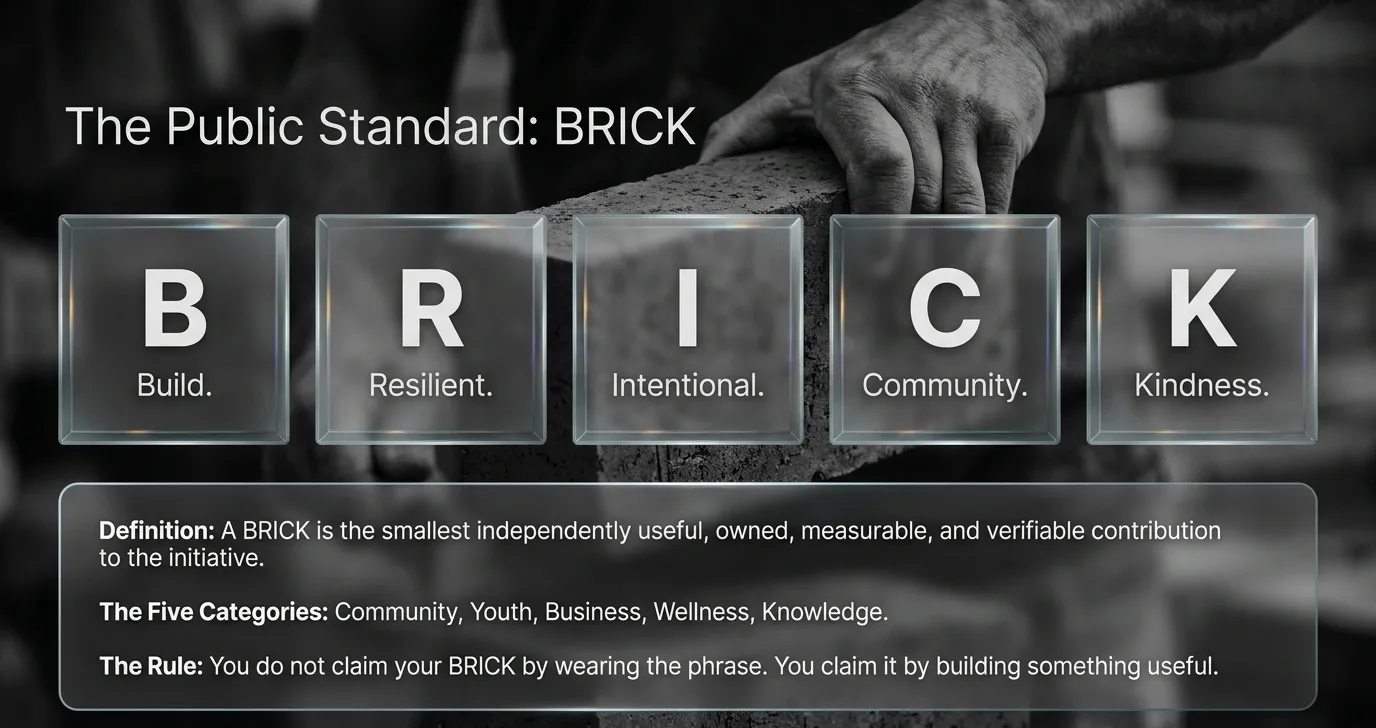
You do not claim your BRICK by wearing the phrase. You claim it by building something useful.
Build Resilient Intentional Community Kindness. One BRICK at a time.
A BRICK is the smallest independently useful, owned, authorised and verifiable contribution.
A BRICK does not have to build the entire city. It must create real utility for someone.
Kindness here does not mean charity or softness. It means useful action that respects people, strengthens community, and creates value without exploitation.
The model is deliberately small. We do not rely on a single massive organisation. We rely on small, credible, independent actions that eventually form something permanent — every piece worthwhile on its own, every genuine connection making the whole stronger.
The governing rule
Signing up reserves responsibility. Delivery earns the claim.
BRICK
The unit of contribution
A single, independently useful thing that someone owns and delivers. One person, one business or one institution builds a BRICK. It has a name, an owner, a beneficiary, and evidence that the promised value arrived.
Build a BRICK. Every BRICK must have a clear owner. What BRICK will you build?
BRICKⓈ
The participation environment
The wider authored system those contributions live inside — the categories, the ten questions every proposal must answer, the lifecycle from proposed to claimed, and the governance that decides when a claim is earned.
Explore the BRICKⓈ participation system. An initiative such as Philadelphia: Built for Pressure invites independently useful BRICKs through it.
Commercial participation
A BRICK does not require financial sacrifice. It requires independently useful community value.
The question a restaurant, employer, sponsor or local business actually asks is simple: can we benefit from this and still build a legitimate BRICK? Yes — and here is exactly how that stays honest.
- A participating business may generate revenue
- Project Inside Out may earn authorized operating revenue
- TRUFiT Connect may earn authorized technology or administration revenue
- The participant must receive genuine utility
- The community contribution must remain independently useful
- Delivery and value must be documented and validated
Neither direction of the shortcut works. Commercial benefit does not invalidate a BRICK — and earning money does not, by itself, make an activity one.
The community-value test
What separates meaningful commercial participation from ordinary promotion presented as community contribution.
The test is never whether someone earned money. It is:
Did the activation deliver the promised community utility?
Was the commercial benefit transparent?
Was participation voluntary and relevant?
Was the contribution evidenced and validated?
Would the contribution still be useful without the marketing claim?
The five public categories
Where could you build?
Five kinds of contribution. None of them are claimed by turning up.
Validated BRICKs 0
-
Community
Strengthen a neighbourhood’s ability to hold up under pressure.
Community
Strengthen a neighbourhood’s ability to hold up under pressure.
Strengthens a neighbourhood, local group, civic relationship or shared public environment.
What this could look like
- Hosting a community conversation
- Providing meals or services
- Supporting a family
- Improving a public or shared space
- Connecting residents to resources
- Restoring recreation space
Possible ways to contribute
- provide space
- support delivery
- connect an audience
- provide expertise
- start a conversation
Possible proof
- People served
- Utility delivered
- Participation
- Services completed
- Connections made
- Continuation
Nothing here is scheduled. This starts a conversation, nothing more.
-
Youth
Help young people prepare for pressure, transition, or opportunity.
Youth
Help young people prepare for pressure, transition, or opportunity.
Helps young people build confidence, resilience, opportunity, leadership, identity or practical readiness.
What this could look like
- A Mind Warriors clinic
- Mentorship or an internship
- School or sports support
- Equipment, transportation, scholarship support
- Career exposure and college-transition guidance
- Coach development
Possible ways to contribute
- provide expertise
- provide space
- support delivery
- connect an audience
- start a conversation
Possible proof
- Youth reached
- Sessions delivered
- Opportunities created
- Resources provided
- Participant feedback
- Readiness outcomes
Nothing here is scheduled. This starts a conversation, nothing more.
-
Business
Put commercial capacity to work in a way that stands on its own.
Business
Put commercial capacity to work in a way that stands on its own.
Uses commercial capacity to create measurable customer, participant or community value.
What this could look like
- Hosting a PINTⓈ gathering
- Providing a participant benefit
- Offering an internship
- Acting as a local Business Node
- Providing meeting or event space
- Food, transportation, hospitality or technology
Possible ways to contribute
- provide space
- provide a service or product
- connect an audience
- support delivery
- start a conversation
Possible proof
- Visits
- Services delivered
- Qualifying actions
- Transactions
- Return on Activation
- Repeat participation
Nothing here is scheduled. This starts a conversation, nothing more.
-
Wellness
Support how people recover, regulate, and keep going.
Wellness
Support how people recover, regulate, and keep going.
Improves emotional, physical, relational, transition or performance readiness.
What this could look like
- A STAI-Well conversation
- A parent transition reset
- Stress-management education
- Movement, recovery, mobility
- Healthy meal support
- An intentional run or walk
Possible ways to contribute
- provide expertise
- provide space
- support delivery
- connect an audience
- start a conversation
Possible proof
- Participation
- Utility delivered
- Feedback
- Practices adopted
- Readiness indicators
- Referral to resources
Nothing here is scheduled. This starts a conversation, nothing more.
-
Knowledge
Make something understandable that people can actually use.
Knowledge
Make something understandable that people can actually use.
Provides useful insight, education, expertise, technology, research or lived experience.
What this could look like
- A professor-led conversation
- A founder discussion
- An athlete pressure story
- An AI and human-readiness session
- A workshop, research or a practical guide
- Career information and professional mentoring
Possible ways to contribute
- provide expertise
- help produce something
- connect an audience
- support delivery
- start a conversation
Possible proof
- Knowledge shared
- Resources created
- Decisions improved
- Actions resulting
- Collaborations formed
- Learning retained
Nothing here is scheduled. This starts a conversation, nothing more.
Nothing here is finished. That is the point.
Before it is authorised
Ten questions every BRICK must answer
What is being built?
Who benefits?
Who owns delivery?
What utility is provided?
What resources are required?
What authority or permission is required?
How is participation validated?
What measurable value is created?
What evidence confirms delivery?
What happens afterward?
Ownership is not restricted to one kind of entity. An individual mentor, a restaurant providing space, a community leader organising an activation, a coach, a researcher — each can own a BRICK. The owner is the party accountable for independent utility and measurable proof.
The lifecycle
A BRICK is not claimed because someone likes the idea.
- Proposed
- Reviewed
- Accepted
- In development
- Scheduled
- Delivered
- Validated
- Claimed
- Continuing
Wearing a shirt, posting the phrase, submitting an interest form, receiving approval to explore, or appearing at an event does not claim a BRICK. A BRICK becomes claimable when it has defined utility, named ownership, a credible action, participant or community value, authorisation, delivery, validation, measurable proof and independent usefulness.
Contribution roles behind the categories
The five categories are public. Behind them, TRUFiT Connect records the role a contributor actually performs — which is how a restaurant providing the place for a community conversation facilitated by an expertise contributor stays legible.
- Experience
- Place
- Utility
- Audience
- Expertise
- Production
- Commerce
- Proof
And afterward
- Continue or expand what proved useful
- Connect to other BRICKs to form something larger
- Preserve the relationships and commitments that emerged
- Apply the learning somewhere else
- Earn the recognition — only after the utility is validated
Philadelphia: Built for Pressure
Claim your 🧱 BRICK.
Your BRICK does not need to build the whole city. It needs to create something useful, withstand scrutiny, and connect with purpose.
Before a BRICK exists, there is a conversation.
Every BRICK begins the same way — someone describes something useful they could build, and we work out together whether it holds up. There is no queue to join and no form to fill in. There is a conversation, and it either turns into something real or it honestly doesn’t.
If you have an idea, or only the beginning of one, tell us about it.
Send a short note
Four things help most: who you are, what you are thinking of building, who it would help, and where you are. All of them are optional, and a few sentences is plenty — this is the start of a conversation, not an application.
Or write to us directly at bricks@projectinsideout.info
What happens after you send
A person reads it — usually Adrian. If it is worth pursuing, you will hear back and we will talk it through. If it isn’t the right fit, or the timing is wrong, we will tell you that plainly rather than leave you waiting.
We cannot promise a response time yet. This is a small operation, and saying otherwise would be the first thing we got wrong.
Sending a note does not create a BRICK. It is not a submission, a registration or an approval, and it does not reserve anything. A BRICK becomes real only when it has been defined, owned, authorised, delivered and validated — and delivery is what earns the claim. The system that governs those steps is still being built, so nothing described on this site has been authorised, delivered or claimed unless separately stated.
Keep exploring