
TRUFiT Connect
Participation, made into an organised and continuing relationship.
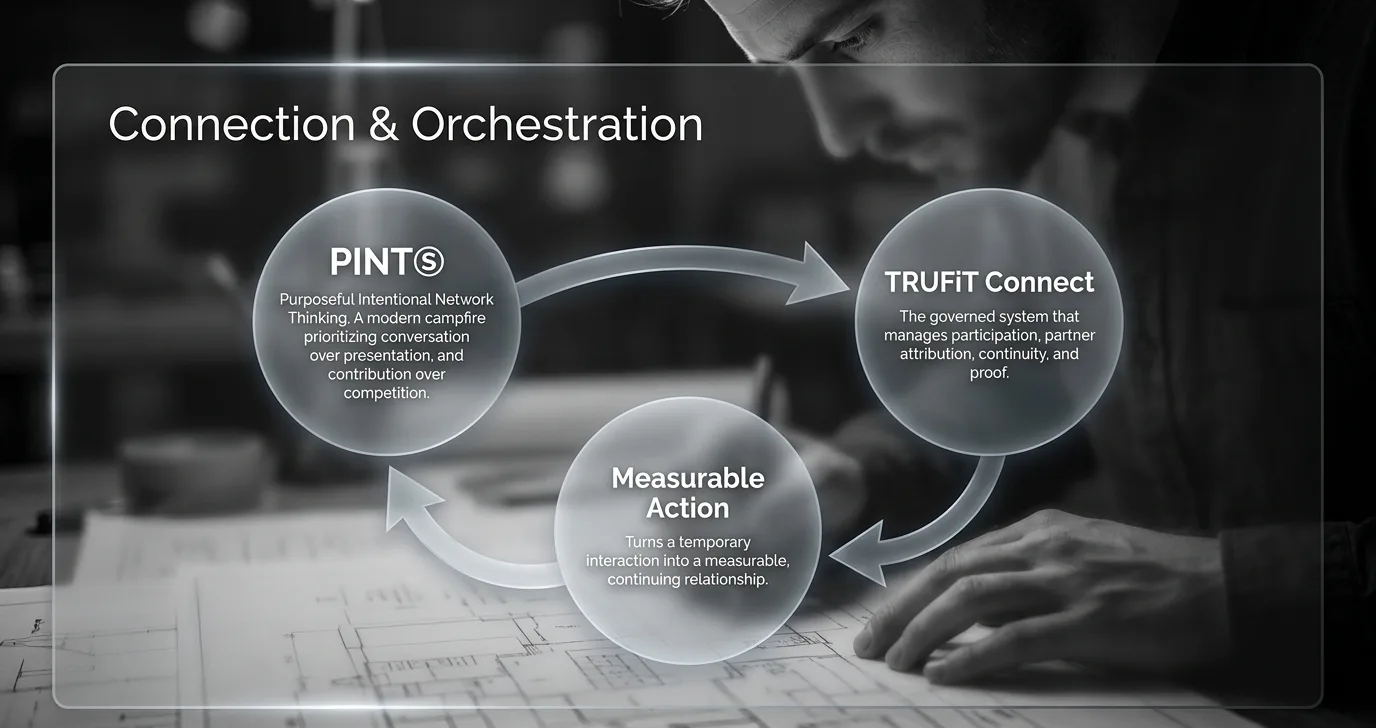
The governed connection and activation system that coordinates people, organisations, BRICKs, invitations, roles, participation, attribution, follow-up, continuity and proof.
What it answers
The questions that decide whether something actually happened.
- Who is involved, and why?
- What are they contributing, and who benefits?
- What has been promised, and what still requires approval?
- What activation is being formed?
- How does someone register or participate?
- How did the person enter, and who should receive attribution?
- What happened, and what evidence exists?
- What happens next?
It is not merely a contact database. It connects relationships, opportunities, participation, activation formation, communication, delivery, evidence and continuation.
Touchpoints
The credential carries a reference, not the entire truth.
A person may encounter TRUFiT Connect through a QR code, a barcode, a link, NFC, a mobile-wallet pass, a message, an event credential, a registration page, an access credential — or an interface that does not exist yet.
What it coordinates behind those touchpoints: relationships, opportunities, roles, invitations, activation formation, participation, attribution, evidence, validation, follow-up and continuation — whether that is a BRICK, a CANEⓈ gathering, a PINTⓈ conversation, or an initiative inside Built for Pressure.
The touchpoint is not the system. Touchpoints provide access; TRUFiT Connect provides the governed connection and continuity. A QR code may be used today and a different technology may carry the same relationship tomorrow.
Credential principle
A public credential should not contain the complete sensitive record. It should carry an opaque, revocable reference that TRUFiT Connect resolves into the authorised context. Sensitive information is not publicly encoded into the touchpoint.
Touchpoint types
- Activation
- Partner
- Participant credential
- Invitation
- Referral
- Access
- Offer
- Redemption
- Follow-up
- Proof submission
Each touchpoint has a defined purpose and a permitted action.
The participation flow
From a scan to something that continues
-
01
A person encounters a governed touchpoint
Physical or digital, in a venue or in a message.
-
02
TRUFiT Connect resolves the context
The person sees the authorised invitation, role or action — not the internal record.
-
03
Registration, consent or participation is recorded
And attribution is preserved against the invitation, promoter, partner, BRICK and activation.
-
04
The activity or utility is delivered
This is the step that matters. Everything before it is arrangement.
-
05
Evidence and follow-up are recorded
And the relationship continues where continuing is appropriate.
Analytics and proof
A scan is not proof that utility was delivered.
Analytics must distinguish between interest, registration, attendance, delivery, completion, proof and outcome. Collapsing those into one number is how activations come to look successful without being useful.
Potential
A party’s capacity to provide something. Not evidence that it has committed it.
Committed
A formally committed contribution, with authority recorded.
Delivered
The contribution actually happened.
Evidenced
Sufficient evidence exists to support the precise claim being made.
Attribution
Attribution preserves the relationship between the participant, the invitation, the promoter, the partner, the BRICK, the activation, the offer and the resulting action. Attribution does not automatically create compensation — any compensation, credit or revenue share requires separately authorised terms, a qualifying action and evidence.
The Command Center
TRUFiT Connect defines and performs the connection and activation orchestration. The Command Center is the governed internal workspace through which authorised people manage it. The public does not need this distinction — but the architecture does.
The commercial dimension Proposed
TRUFiT Connect is the governed commercial orchestration capability through which Project Inside Out can form, activate, attribute, document, validate, and measure participation.
The aim is straightforward: TRUFiT Connect can enable organizations to participate profitably in community well-being while documenting what they contributed, who engaged, what authorized transactions occurred, and what value was created.
Where money is involved, the boundaries already on this page hold. External payment processors would handle payments; credentials would carry opaque references rather than identity or payment data; and a scan would prove only the interaction it represents — never delivery, community utility, or an earned claim.
Proposed future models — none is an active service
- Activation setup
- Partner subscriptions
- Managed activations
- Registration administration
- Program licensing
- Credential & check-in infrastructure
- Attribution administration
- Return-on-Activation analytics
These are possibilities under consideration, not services with pricing. Each would be described as operating only once individually implemented, authorized and evidenced.
Boundaries
What TRUFiT Connect is not
- Not a barcode company
- Not a social-media network
- Not a payment processor or a bank
- Not an autonomous partnership authority
- Not a replacement for human approval
- Not proof that an activation has occurred
- Not permission to publish an unconfirmed relationship
Entering information does not create authority. No opportunity advances from exploration into formation or delivery without an explicit record of role, intellectual property, time commitment, authority, responsibilities, deliverables, expense exposure, risk, attribution and compensation structure. Human authority comes before automated action.
Keep exploring