
STAI
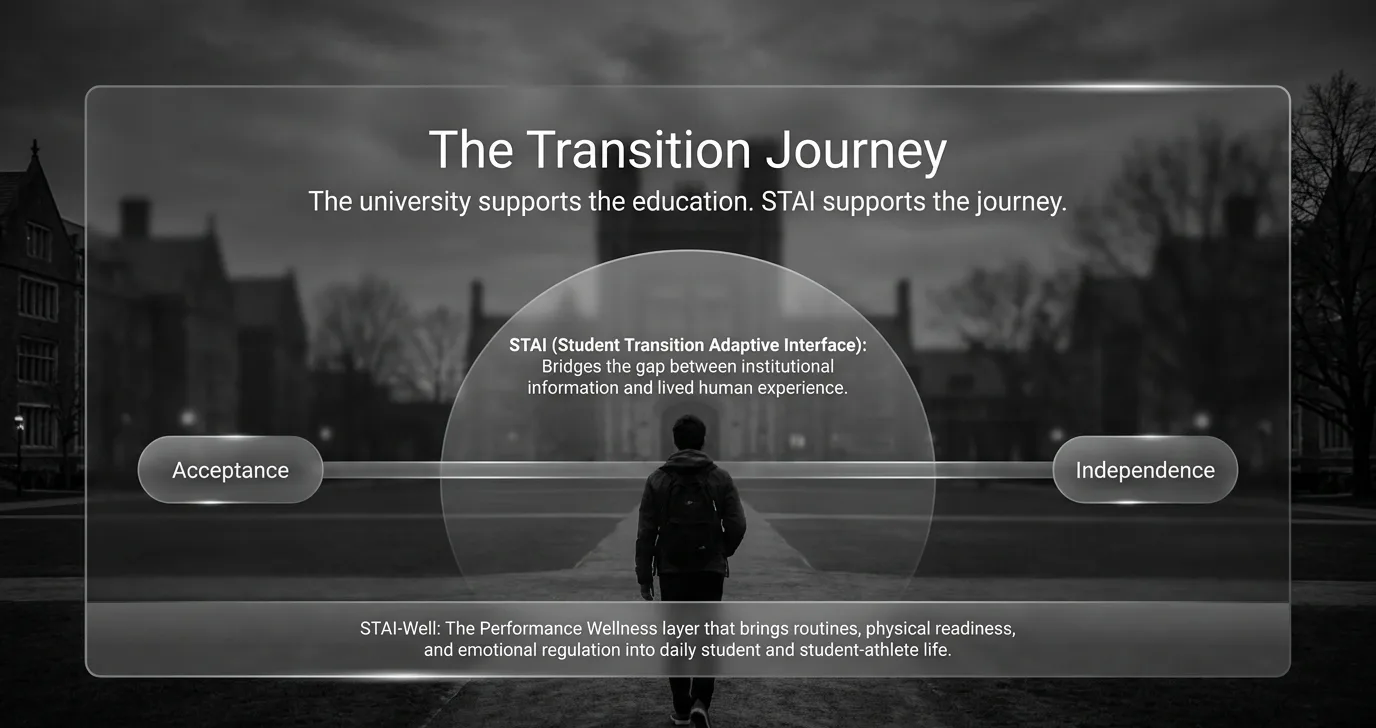
The university supports the education. STAI supports the journey.
STAI — pronounced “stay” — is the Student Transition Adaptive Interface, designed to help students, parents and supporters navigate the journey from acceptance to independence.
Why STAI exists
Institutional information and human transition are not the same thing.
University transition is usually communicated as a sequence of institutional tasks: accept the offer, pay the deposit, submit the forms, attend orientation, move in, register, begin classes.
The human experience includes emotion, separation, identity, relationships, money, safety, health, routines, belonging, independence, uncertainty and family change.
Universities may provide a great deal of information and support. The challenge is that students and families must still translate institutional information into personal decisions and daily life. STAI is designed to help bridge that gap.
The three surfaces
What a member actually touches
STAI-C
The adaptive concierge
Conversational, context-sensitive guidance grounded in verified sources. Its role is to provide contextual guidance based on the person’s role, school, stage and need — helping students build independence by solving problems self-sufficiently, and helping parents support from a distance without taking over.
Claims track implementation
STAI-D
The transition dashboard
The structural hub. It organises transition information, stages, tasks, verified milestones, role-relevant priorities, readiness items and pathways — turning a scattered web of deadlines into a visible journey.
Claims track implementation
STAI-Well
The Performance Wellness layer
The Performance Wellness experience layer within STAI@School. Guided content, practical tools, repeatable practices and approved Performance Wellness Activations that help students, parents and supporters remain well while moving through transition.
Underneath the surfaces
Three layers make the guidance trustworthy
IKONInstitutional Knowledge Operational Network
The trusted knowledge base. It answers what is institutionally true by organising authoritative school information — deadlines, housing requirements, academic calendars, policies — while preserving the source and its verification status.
STAIAdaptive guidance
The individualised layer. It answers what does this mean for me, and what should I do next by applying a member’s voluntarily provided context — role, school, stage, location — to verified institutional fact.
CANEⓈCommunity Aligned Networking Experiences
The human layer. It answers who can help me understand, navigate and
experience this transition by connecting members to peer communities,
mentors and real-world STAI Pop-Ups. It organises people by role, region,
stage, circumstance and lived perspective — and uses the
PINTⓈ
method to structure how they gather and think together.
Explore CANEⓈ
The journey
The transition does not end when the student reaches campus.
- Acceptance
- Preparation
- Orientation
- Move-in
- Separation
- First week
- First 30 days
- First semester
- Growing independence
The student
A student may need support with preparation, schedules, local discovery, campus resources, routines, wellness, peer connection, decision-making, independence, asking for help, managing expectations, and building a support network.
The parent or supporter
Parents are transitioning too: pride, uncertainty, loss of control, concern, grief, relief, identity change, questions about communication, and difficulty knowing when to help and when to step back. Many benefit from perspective, conversation, decompression, a reality check, and practical guidance. Those facing serious distress may need qualified clinical support beyond the scope of a STAI-Well activation.
The continuity principle
It STAI’s with you.
Designed for longitudinal continuity across preparation, arrival, integration, evolution, launch and legacy — so members do not start from zero each time circumstances or roles change.
STAI-Well
People arrive at wellness through a need, not a category.
The activity is the vehicle. The purpose is helping the person move through transition with greater readiness and connection.
Need states
- I need to move.
- I need to slow down.
- I want to meet people.
- I want to explore.
- I need perspective.
- I need to reset.
- I need practical support.
Possible experiences
- A campus walk
- A convergence run
- Breathing or mobility
- A parent transition conversation
- A student gathering
- A local discovery route
- A coffee conversation
- A PINTⓈ experience
- A healthy breakfast
- Reflection
Boundaries
What STAI is not
01 It is not a university system, and no university operates it
02 It is not a clinical mental-health service
03 It is not a generic events calendar or sponsor marketplace
04 Availability is not implied
Keep exploring