
Built for Pressure · Initiative
The YMCA Hornets Mind Warriors Field Test.
The first demonstrated Built for Pressure initiative — and the environment where a coaching philosophy stopped being a philosophy.
The record, stated precisely
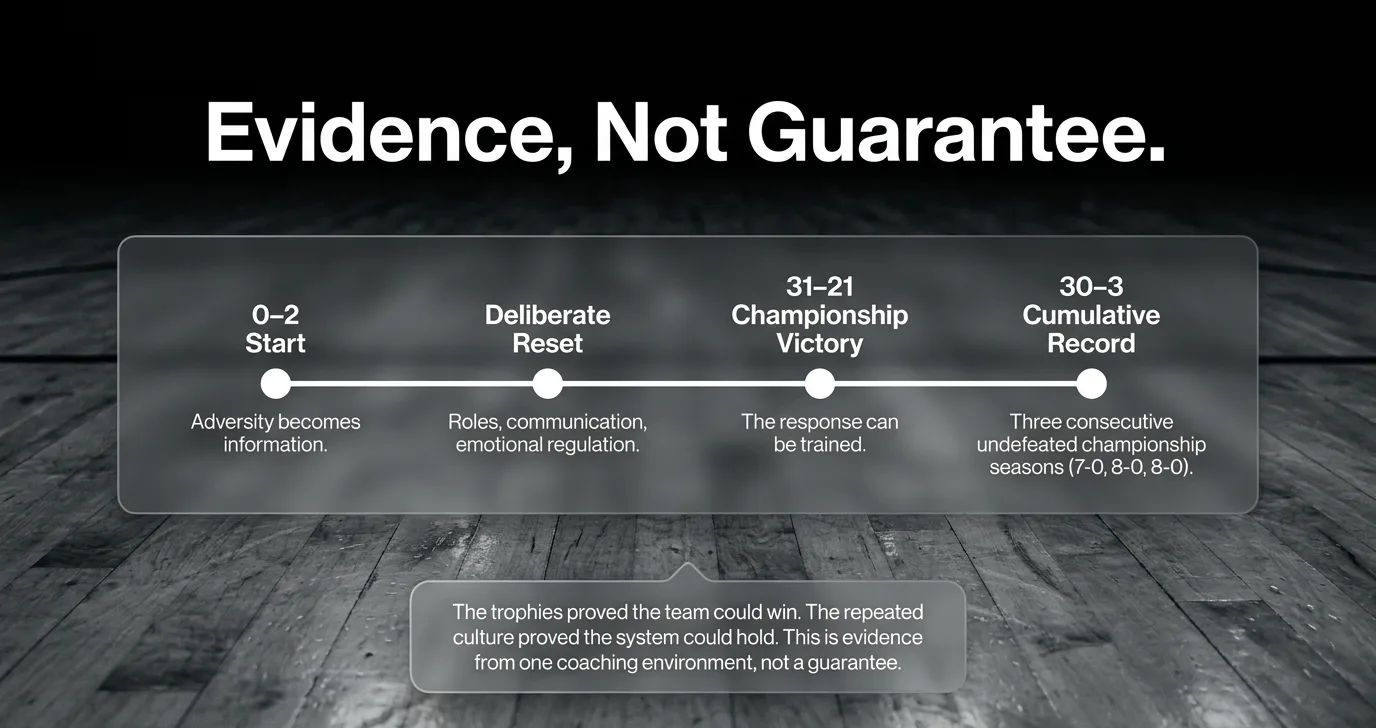
Four seasons with the YMCA Hornets: an 0–2 start, followed by a 30–3 combined record that included three consecutive undefeated championship seasons.
The 0–2 matters as much as the 30–3. Without it, this is a story about winning. With it, it is a story about what changed.
The championships sit inside the combined record — they are not an additional total, and the team was not undefeated across all four seasons.
What the losses exposed
Two games in, the problem was not basketball.
The team lost both games of an opening doubleheader. Treated as a verdict, an 0–2 start is discouraging. Treated as information, it was specific.
What it revealed had almost nothing to do with shooting or conditioning. It was preparation, confidence, role clarity, emotional response, team identity, coaching workload and culture — the things nobody schedules practice for.
- Players did not share a definition of who the team was
- Roles were unclear, so effort went to the wrong places
- A mistake became a spiral instead of a reset
- Communication stopped exactly when it was most needed
- The coach was carrying so much planning that presence suffered
So the response was not more drills. It was building the thing underneath the drills.
Identity first
A team that can say who it is can recover from anything inside a game.
After the second loss, the Hornets established a shared language. It was not a slogan for energy. It was a reference point players could return to when a game went sideways.
The call and response
Who are we? Hornets.
What do we do? Hustle hard.
One, two, three — SWARM.
Collective identity. Shared effort. Defensive responsibility. Movement. Communication. Accountability. Belonging.
Preparation
Practice with a purpose players could name. Preparation does not guarantee a result — it widens the set of choices available when the game gets hard.
Emotional reset
The skill that separated the seasons. Not avoiding mistakes — returning from them quickly, without carrying the last possession into the next one.
Accountability
Structure without removing humanity. Players understood their role, and understood that the role was real whether or not they liked it that week.
The technology
Assistant Coach AI did the paperwork. It never coached the kids.
During this period Assistant Coach AI developed into an invisible operational support system — practice planning, rotations, strategy preparation, schedules, recaps, documentation and continuity across seasons.
The point was never automation. It was attention. Removing the planning and organising load meant more of the coach was available for observation, communication, mentorship, emotional regulation, teaching, relationships and live judgment during a game.
The boundary
The technology helped prepare the coach.
The coach developed the people.
The people built the culture.
Assistant Coach AI did not independently coach children, evaluate them clinically, make final decisions, or cause the results. Human coaching retained authority, judgment, relationships and responsibility throughout.
Four seasons
What the culture had to survive
-
Season one
0–2, then seven straight
After the identity was established the Hornets won their next seven games before losing in the playoffs. With the final game slipping away, the bench was cleared so the other group of players could compete. The lesson afterward was not blame: learn from this, return stronger.
-
Season two
7–0 — undefeated champions
The first test of whether the system held with a changed roster rather than a specific group of players.
-
Season three
8–0 — undefeated champions
A different pressure entirely: defending success, and coaching players who now expected to win.
-
Season four
8–0 — undefeated champions
Completing the four-season journey at a 30–3 combined record, through roster changes, role dissatisfaction and rising expectations.
The deeper proof
The trophies proved the team could win. The repetition proved the system could hold.
A single championship can be a roster. Three consecutive undefeated seasons through changing players is a culture — identity influencing behaviour, preparation reducing confusion, communication supporting trust, young people learning to reset after mistakes.
This is what makes it a field test rather than a highlight. It demonstrated that Performance Wellness principles and Mind Warriors coaching operated in a real environment with real children and real pressure.
What it does not prove. The record demonstrates that the system worked in that YMCA environment. It does not independently prove the same result in another league, age group, roster or context, and it is not a promise of replication. Any claim of transferability needs its own evidence. Mind Warriors has not been adopted by Nike, the NBA, the 76ers, the YMCA nationally or any other institution.
Keep exploring