
Technology
Technology that gets out of the way of the people doing the work.
AI-assisted capability across Project Inside Out exists to reduce friction — not to take over judgment, relationships or authority.
The governing principle
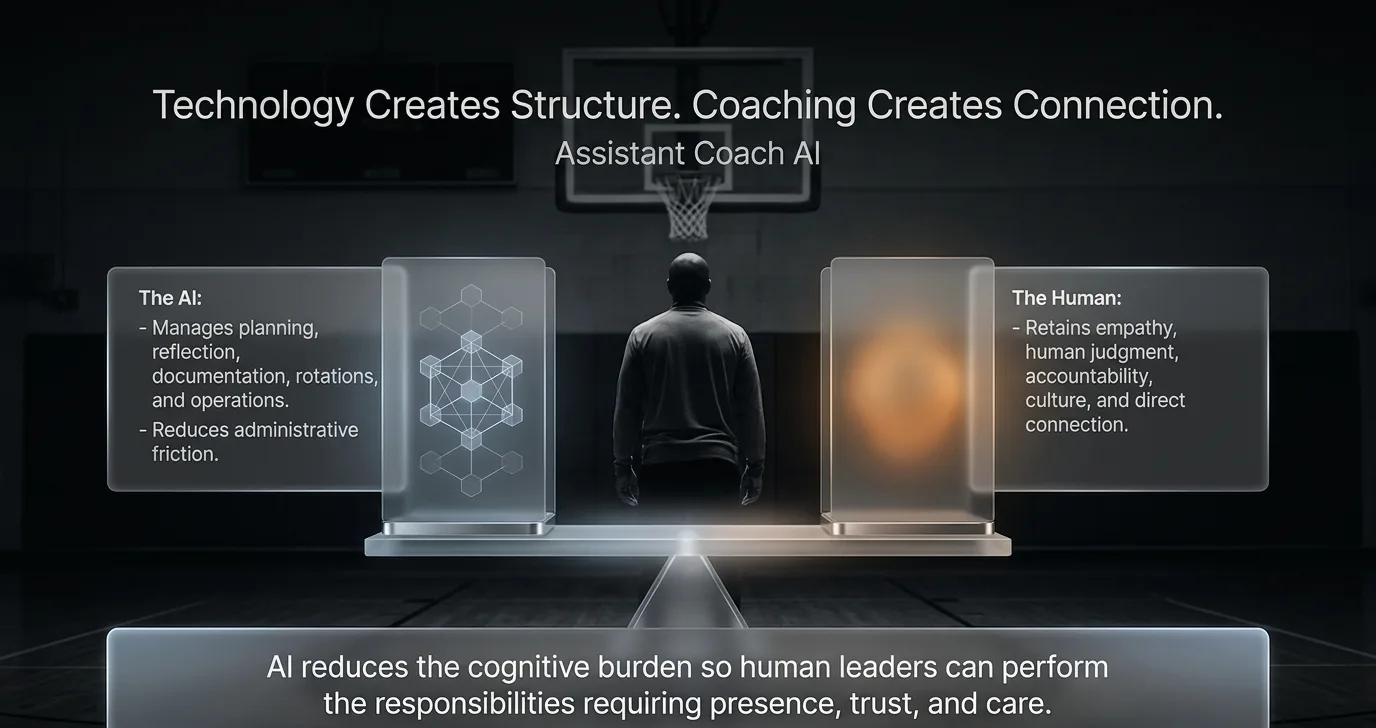
AI should reduce administrative and cognitive burden so humans can perform the responsibilities that require presence, judgment, trust, and care.
Technology here is support infrastructure. It is never the authority over people, programs, participants, students, athletes or community relationships.
The work of coaching, teaching, parenting, leading and building is relational. What exhausts the people doing it is rarely the relational part — it is the planning, scheduling, tracking, documenting, remembering and coordinating stacked on top. That is the load technology should carry.
So the test applied to every capability is not whether it is impressive. It is whether the human at the centre of the work became more present because of it.
Technology carries
- Administrative load
- Cognitive load
- Organisation
- Coordination
- Documentation
- Continuity
Humans keep
- Judgment
- Care
- Leadership
- Observation
- Relationship
- Accountability
- Communication
- Decision-making
- Authorship
- Governance
First demonstrated capability
Assistant Coach AI
Assistant Coach AI is an AI-assisted planning, preparation, strategy, organisation, continuity and documentation capability developed to support the human coach.
It began as a practical response to the planning, rotation, strategy, scheduling, communication and documentation load involved in coaching a youth basketball team. By reducing that friction, it helped the coach devote more attention to players, relationships, culture, emotional regulation and live judgment.
The problem it addressed was not a shortage of coaching knowledge. It was that the administrative weight of a season quietly consumes the attention a coach needs for the twelve people in front of them.
The governing statement
The technology helped prepare the coach.
The coach developed the people.
The people built the culture.
What it supported
- Practice planning
- Rotation development
- Game preparation
- Strategy preparation
- Schedule organisation
- Player-development thinking
- Game recaps
- Documentation
- Continuity across seasons
- Reducing the administrative and cognitive load carried by the coach
Where it was applied
See how Assistant Coach AI was applied during the YMCA Hornets Mind Warriors Field Test.
Four seasons of youth basketball became the first real environment in which the capability was used and observed — including what it changed about the coach’s attention, and what it never touched.
The wider role
What technology does across the rest of the work
Described honestly, at the maturity each one has actually reached.
AI-assisted planningDemonstrated
Preparation, sequencing and documentation support for someone carrying an operational load. This is the Assistant Coach AI story above, and the only capability here with a real field application behind it.
Adaptive guidanceIn development
Interpreting verified information against a person’s role, stage and circumstance so they know what it means for them. This is the intent behind STAI; claims about its specificity and reliability track implementation rather than ambition.
Trusted knowledge organisationIn development
Structuring authoritative institutional information while preserving its source and verification status, so guidance can be traced back to something real rather than generated.
Orchestration, evidence and continuityFoundational
Coordinating roles, invitations, participation, attribution, follow-up and proof. The architecture is authored and the governing rules are set; see TRUFiT Connect.
Capability is not implementation. A described capability is not a shipped one. Nothing on this page should be read as a claim that a system is operating, tested or proven unless it is labelled that way.
For technology and research organisations
Where responsible development would actually matter here.
The pattern on this page — a real human problem, a narrow AI-assisted capability, a hard boundary around human authority, and one demonstrated field application — is the part that would benefit most from development, research and testing rigour.
Areas where that contribution could be genuinely useful:
- Responsible development practice around AI used near young people
- Research design and independent evaluation
- Testing environments and reproducibility
- Privacy, consent and data-minimisation review
- Evidence infrastructure — what counts as proof, and how it is preserved
- Documentation standards that survive handover
- Expansion beyond a single coach in a single league
Organisations may eventually contribute expertise, research, development support, testing environments, production capability or evidence infrastructure through an authorised BRICK. Formal roles, commitments, attribution, evidence and continuation would be governed through TRUFiT Connect.
Nothing here is an existing arrangement. No technology, innovation, research or development organisation has agreed to participate, and no contribution described above has been proposed, authorised or accepted. This section explains where relevance could exist — not that it does.
Keep exploring